Funding a Grassroots Football Club in the UK
Key takeaways
- Most families pay £100 to £300 a year per child; clubs running several teams can need £10,000 or more a season.
- Football Foundation, National Lottery Awards for All, Sport England Movement Fund and Be Active Wales Fund all offer accessible grants from £300 upwards.
- Local sponsorship, events and crowdfunding turn community goodwill into a repeatable income source when a club commits to two or three, not eight.
- A print-on-demand club shop and a matchday drinks table both generate income with no stock risk and almost no setup.
- The Season Stats Board pays clubs £5 per board sold, with no admin, stock or events required.
A GAROE Group Guide
Funding a Grassroots Football Club in the UK: Grants, Fundraising Ideas and Realistic Numbers for 2026/27
Most club committees already know the honest version of running a grassroots team: subs cover the predictable costs and nothing else. Pitch hire, referee fees and affiliation charges get paid on time. Everything else, from a new set of goals to a minibus for an away tournament, gets funded through goodwill, a car boot sale, or a chairperson quietly covering the gap themselves.
This guide sets out where that extra funding can realistically come from. It covers what UK families currently pay to keep a child playing, and the grant schemes worth applying for in 2026/27.
It also covers a few lower effort ways to raise money that do not rely on running an event every few weeks. We have included a Season Stats Board section below, since it is one of the ways we help clubs raise funds directly through GAROE, alongside grant income rather than instead of it.
What Grassroots Football Actually Costs a Family
There is no single national figure that applies to every club, since costs depend on whether a club owns its pitch, employs coaches, or runs purely on volunteers. But across parent discussions and club fee guides, a consistent range emerges.
Most families pay somewhere between £100 and £300 a year for one child to play, covering a weekly training session, league matches, and basic kit. Clubs with a clubhouse, paid coaching staff, or higher-tier facilities often sit at the top of that range or above it.
On top of the headline fee, most clubs also ask for smaller contributions along the way. A modest £1 to £3 per match to help cover pitch hire and officials is common, and kit is usually a separate cost from subs, typically £30 to £80 depending on whether it is a full home and away set.
The club side of the ledger is where the pressure really sits. Junior pitch hire alone can run from around £500 a season for a single weekly booking up to well over £1,000 a year once you account for winter 3G surcharges.
Referee fees land every single weekend, typically £25 to £35 a game. A club running seven or eight teams across the age groups can easily need £10,000 or more a year just to keep everyone playing, before a single new piece of kit or equipment is bought.
That gap between what subs bring in and what a season actually costs is the reason grant funding and additional fundraising exist. Neither is a nice to have. For most clubs, they are the difference between freezing fees for another year and asking already stretched parents to pay more.
Grant Funding Worth Applying For
Grants will not cover a season’s running costs on their own, but they are the most underused source of funding available to most clubs, largely because the application process feels like more effort than it is.
None of the schemes below require a professional grant writer. They need a clear project, a realistic budget, and evidence that the money will benefit the community your club serves. The table below is a quick comparison, with the full detail underneath for each scheme.
| Scheme | Amount | Best for | Region | Apply |
|---|---|---|---|---|
| Football Foundation | Up to £25,000 (75% match) |
Pitches, goalposts, floodlights, changing pavilions | England | Apply |
| National Lottery Awards for All | £300 to £20,000 | First-time applicants, kit, community projects | England (separate versions for Wales, Scotland, NI) |
Apply |
| Sport England Movement Fund | £300 to £15,000 | Reducing inactivity, tackling inequalities | England | Apply |
| Be Active Wales Fund | £300 to £50,000 (10% club contribution) |
Youth programmes, coaching courses, equipment | Wales | Apply |
Figures correct as of August 2026. Grant amounts, windows and eligibility rules change, so always check the funder’s own page before applying.
Football Foundation
The Football Foundation is the largest single source of grant funding for grassroots football in the UK, backed jointly by the Premier League, the FA and the Government. Most facility grants go up to £25,000 and typically cover up to 75% of a project’s cost, so a club still needs to find the remaining share itself or through a local partner.
Funding covers goalposts, floodlights, changing pavilions, pitch improvements and similar capital projects. It does not cover kit, equipment, routine maintenance, or facility hire, and projects must be based in England. Applications are accepted year round, and not-for-profit clubs, community organisations and local authorities are all eligible.
National Lottery Awards for All
This is usually the best starting point for a club that has never applied for a grant before. Awards for All offers £300 to £20,000 for projects that bring people together, improve local spaces, or help people in the community reach their potential. A new set of training kit paired with a come-and-try session for new players is a realistic example of what qualifies.
The application is short, decisions typically come back within 16 weeks, and you do not need to be a registered charity. A constituted club with a committee and a bank account requiring two unrelated signatories is enough.
Sport England Movement Fund
Sport England’s older Small Grants programme has closed and been replaced by the Movement Fund, which offers £300 to £15,000 with no submission deadline, though applications need to go in at least 12 weeks before you plan to start spending.
It is aimed squarely at projects that get inactive or less active people moving, and at reducing inequalities in who gets to take part. An application framed around widening access, such as a girls’ team starting up or a reduced-fee place for a family struggling with costs, tends to fit its priorities better than a straightforward equipment request.
Be Active Wales Fund
Clubs based in Wales have their own dedicated route through the Be Active Wales Fund, offering grants between £300 and £50,000 for equipment, facility improvements, and coaching or officiating courses. It runs through Sport Wales rather than the England-only schemes above.
Unlike Awards for All it is not a rolling programme: applications go through set windows across the year, usually opening in April, July and November, and the club needs to have submitted an expression of interest before the full application. A minimum 10% contribution from the club towards the total project cost is also required, so it is worth budgeting for that before applying.
A few things make an application stronger across all of these schemes: clear participation numbers, a specific project rather than a vague request for “funding,” and evidence that the club serves the wider community, not just its existing members.
Most funders explicitly ask how a project increases or sustains participation, so a short line connecting the ask to more children playing, or a club staying affordable, is worth including even where the form does not ask for it directly.
Community Fundraising That Actually Works
Grants take weeks to arrive and are never guaranteed. Community fundraising is slower to build but more predictable once it is running, and it does something grants cannot: it turns parents, local businesses and the wider neighbourhood into people who feel like they have a stake in the club.
The trap most committees fall into is trying eight different ideas at once and running all of them half heartedly. A club that picks two or three and commits to running them properly, every season, will out-raise one that tries everything once and drops it.
Local Business Sponsorship
This is usually the single most reliable source of extra income a club has, and it costs nothing but time. A local tradesperson, café or independent shop sponsoring a kit is the classic version, and the numbers are worth knowing before you approach anyone. The table below is a rough sponsorship price guide, useful as a starting point for your own tiers rather than a fixed rulebook.
| Sponsorship type | Typical cost to sponsor | What the business gets |
|---|---|---|
| Full kit sponsorship | £480 – £630 | Logo on shirts for one squad, one to two seasons |
| Kit branding package | £250 – £2,000 | Front, sleeve or back placement, scales with age group and visibility |
| Pitch-side board | £200 – £500 / year | Branded board at the ground, renewed annually |
| Event sponsorship | £200 – £1,000 | Named sponsor of a tournament or presentation day |
The businesses most likely to say yes are the ones with an existing connection to the club: a sponsor’s own child playing, a shop near the ground, or a business that already knows several families on the touchline.
Free-matching services such as Kit Funder also exist to connect clubs with businesses actively looking to sponsor grassroots kit, which is worth trying alongside approaching local contacts directly. A short checklist before you start approaching anyone:
Events and Match Days
Five-a-side tournaments, charity matches and presentation days bring in money through entry fees, raffles and on-the-day spending, and they double as the kind of event that keeps parents and the wider community engaged with the club.
These events take real organising effort, so they work best as an annual fixture the club builds a reputation for, rather than something attempted every few weeks with a shrinking pool of volunteers to run it. A rough sense of what each format returns for the effort involved:
| Event | Realistic return | Volunteer effort |
|---|---|---|
| 5-a-side tournament | £400 – £1,200 | High, several weeks planning |
| Raffle at a presentation day | £100 – £400 | Low, piggybacks an existing event |
| Charity match | £200 – £800 | Medium |
Raffles, Prize Draws and Crowdfunding
Raffles with prizes donated by local businesses remain one of the simplest ways to raise a few hundred pounds at a presentation day or tournament, and cost almost nothing to run.
For a bigger, one-off need, such as a defibrillator, new goals, or a minibus, Crowdfunder’s sports club platform lets a club tell a specific story and ask the wider community directly. Clubs on Crowdfunder can apply for match funding from partners including Sport England and Sport Wales, though eligibility depends on the specific fund.
Crowdfunder charges a standard 3% plus VAT fee on funds raised through a project, detailed on their fees page. Crowdfunding works best for a single, well-defined project with a clear target figure rather than an ongoing general fund, since people give more readily when they know exactly what their money is paying for.
easyfundraising is also worth setting up, since it costs the club nothing: supporters shop online as normal through participating retailers and a small commission is donated to the club automatically, with zero admin once the page is set up.
None of the above needs to run constantly. One solid annual event and a small number of sponsors renewed each season will raise more, with less volunteer burnout, than trying to run something new every month. The next section covers a different kind of income altogether, one that runs quietly in the background rather than needing an event to hang it on.
Commercial Fundraising: Merchandise and Product-Based Income
Community fundraising relies on people showing up to something. Commercial fundraising works differently: it turns everyday spending that parents and supporters are already doing into money for the club, with far less ongoing effort once it is set up. This is the category worth building out properly, because unlike a raffle or a tournament, it keeps generating income between events rather than only on the day.
The Club Shop, Done Properly
The simplest version of a club shop is not clothing at all. A cool box of soft drinks and an honesty-priced snack table at the side of the pitch on matchday turns the parents and siblings who are already standing there watching for an hour into paying customers, with almost no setup.
A few crates of drinks, a box of crisps and chocolate bought in bulk from a cash and carry, an ice box to keep things cold, and a handwritten sign with prices is genuinely the whole operation. The only real requirement is a volunteer willing to stand behind the table and take cash or card payments.
A five-a-side tournament or presentation day is exactly the kind of high-footfall event where this earns the most for the least effort. Margins on drinks and snacks bought in bulk are typically 50% or more, and unlike a hoodie order, there is no design, no printing lead time, and nothing to personalise.
The next step up from a matchday drinks table is a proper club shop selling branded clothing and accessories: a hoodie with the club badge, a training top, a bobble hat or a car sticker. It carries a small margin individually, but it is steady income, and every item worn to the school run or the supermarket is free advertising for the club.
The mistake most committees make is treating this like a stock-holding retail business run by volunteers. Nobody wants to be the person storing forty unsold hoodies in a garage.
The fix is print-on-demand or pre-order batches: nothing gets made until it is paid for, so there is no upfront cost and no risk of dead stock. UK suppliers such as Teemill let a club set up a branded online store for free, with items printed and shipped only once ordered.
Personalised and Milestone Products
Personalised products sit in a different category to generic merchandise, because parents are not just buying a branded item, they are buying a keepsake tied to their own child’s season. A shirt with a badge on it competes with every other hoodie in the family’s wardrobe.
A product that marks a specific season, a specific squad number, or a specific milestone does not have that competition, and it tends to convert at a much higher rate because the buyer already wants it before they have seen the price.
This is also the category where a fundraising product can be structured to pay the club directly on every sale, rather than the club having to run the sale itself. That is the model behind the Season Stats Board, below.
The Season Stats Board: Fundraising Built Into a Product Parents Already Want
We built the Season Stats Board because most fundraising asks parents for money on top of what they already spend. This works differently. It is a personalised product parents want to buy for their child regardless of whether the club needs the money, and the club still benefits every time one is sold.
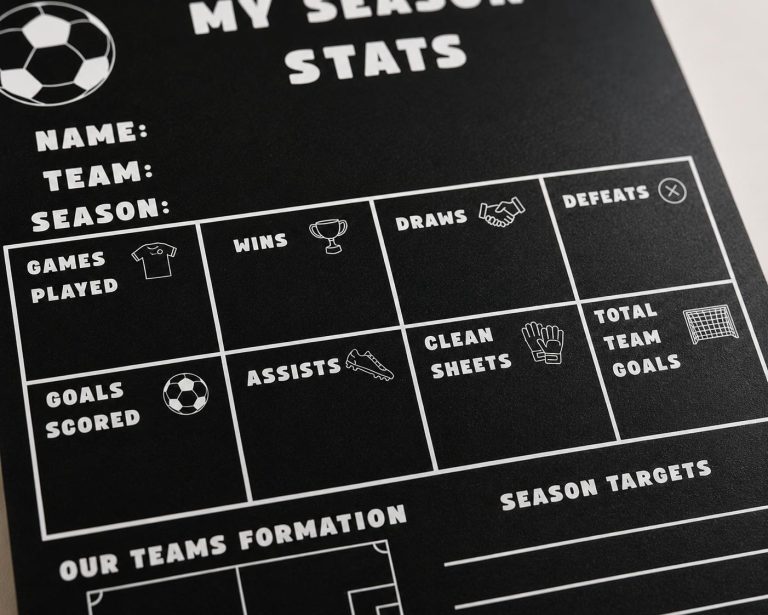
Season Stats Board
An A3 dry-wipe board, personalised with the club’s branding and the player’s details, that families use to track goals, assists and appearances across the season. Every board sold puts £5 directly into the club’s funds, with no admin, no stock, and no upfront cost to the club.
The reason this works as fundraising rather than just merchandise is the same reason personalised products convert well in the first place: a parent is not being asked to donate, they are buying something they already want, a way to mark their child’s season that sits on a bedroom wall or in the kitchen.
The club earns from the sale without running an event, holding stock, or chasing payments, and it sits alongside grants and community fundraising rather than replacing either.
If your club wants the full picture, including how the £5 referral compares to a raffle or sponsorship board, and how to get your club added to the list, our Season Stats Board launch article covers it in more detail.
Where to Start This Season
Trying to do everything in this guide at once is how fundraising plans stall before they start. A realistic first season looks more like the checklist below, spread across the year rather than attempted in one committee meeting.
None of these are quick wins on their own. Together, run consistently over a season, they are usually the difference between a club that has to raise fees every year and one that does not.